


A portable power station is a big rechargeable battery with household sockets. In an outage it runs a fridge, a CPAP machine, a router, lights and phones, silently and safely indoors, which a petrol generator never is. Paired with solar panels, it recharges without fuel.
We compared power stations on capacity (watt-hours), output (watts), battery chemistry and lifespan, how fast they recharge, and the sockets they offer, from a small unit for phones and lights to a big one that can keep a fridge cold.
 Best overallJackery Explorer 1000 v2Check price
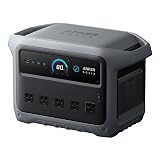 Best for medical devicesAnker SOLIX C1000 Gen 2Check price
 Best valueBLUETTI AC180Check price
 Best small stationJackery Explorer 300Check price

Jackery Explorer 1000 v2
For: keeping a fridge, lights and phones going through an outage
- Capacity1,070 Wh, LiFePO4
- Output1,500 W (3,000 W surge)
- Recharge1 hr (app emergency mode)
- AC3 pure sine wave
The size most households want: about a kilowatt-hour, enough per our rule of thumb to run a typical fridge for most of a day, and 1,500 W of output for a kettle or microwave in short bursts. Jackery rates its LFP battery at over 70% capacity after 4,000 cycles, and it recharges from the wall in about 1.7 hours by default, or one hour in the app's emergency mode.
Solar panels are sold separately, and Jackery says the 1000 v2 charges only from its own panels.
What we like
- Right capacity for a fridge
- Long-life LFP battery
- Very fast recharge
Watch out for
- Solar only with Jackery panels
- Fast charging needs the app
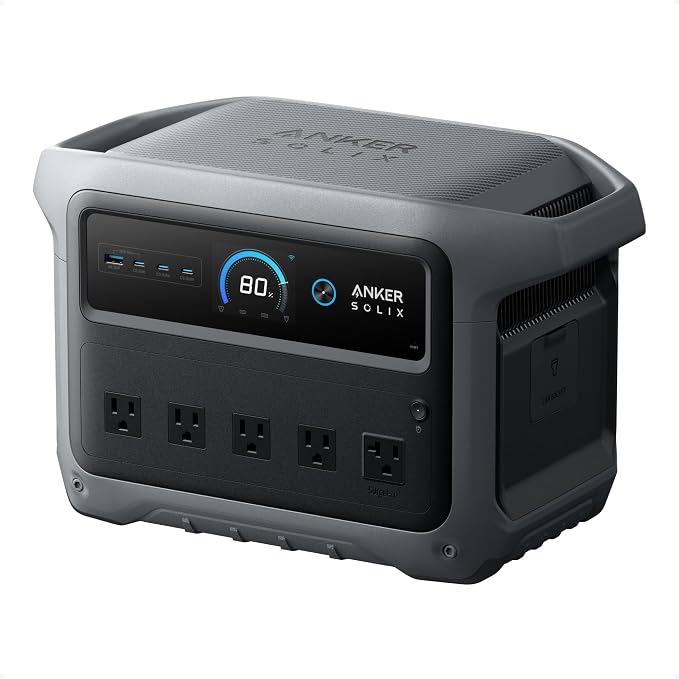
Anker SOLIX C1000 Gen 2
For: a CPAP, a home office or anything that mustn't switch off
- Capacity1,024 Wh
- Output2,000 W (3,000 W peak)
- UPSUnder 10 ms
- SolarUp to 600 W
Anker's power station switches over in under 10 milliseconds when the mains fail, so a CPAP, a router or a computer plugged through it keeps running as if nothing happened. It has 2,000 W of output across 10 ports, recharges fully from the wall in about 49 minutes, and takes up to 600 W of solar. Anker rates the battery at 80% after 4,000 cycles.
If you rely on a medical device, confirm its power draw with the supplier.
What we like
- Very fast UPS switchover
- High output
- Fast wall and solar recharge
Watch out for
- Costs more than the Jackery
- Fast charging is enabled in the app

BLUETTI AC180
For: the most capacity and output for the money
- Capacity1,152 Wh, LiFePO4
- Output1,800 W (2,700 W boost)
- SolarUp to 500 W
- Warranty5 years
More capacity than the Jackery for less money, with 1,800 W from eight outlets, a full recharge in about an hour from the wall, up to 500 W of solar and a UPS switchover of 20 ms, plus a five-year warranty. Solar and car charging cables are included.
What we like
- Most watt-hours per dollar
- Solar cable included
- Five-year warranty
Watch out for
- Heavier than the newer units
- Slower UPS than the Anker

Jackery Explorer 300
For: phones, laptops, lights and a router through a short outage
- Capacity292 Wh, LiFePO4
- Output300 W (600 W surge)
- Weight7.5 lb
- Ports2 AC, USB-C 100 W, 2 USB-A, car
A small, light station for the essentials: enough to recharge phones for days, run a laptop, a router or a fan through a night, and keep lights on. Jackery rates its battery for over 4,000 cycles, and a 100 W panel brings it to 80% in about 2.8 hours. It's among the most-reviewed power stations on Amazon.
What we like
- Light and easy to carry
- Long-life battery
- Great for phones and laptops
Watch out for
- Won't run a fridge
- Panel sold separately

Anker SOLIX C300
For: laptops, phones and cameras over USB-C
- Capacity288 Wh, LiFePO4
- USB-C2 × 140 W
- AC3 outlets, 300 W total
- Noise25 dB
A compact station built around fast USB-C, with two 140 W ports that charge laptops at full speed, three AC outlets, a car socket and a quiet 25 dB fan. It recharges to 80% from the wall in 50 minutes, and Anker gives it a five-year warranty.
What we like
- Fast USB-C for laptops
- Quiet
- Five-year warranty
Watch out for
- 300 W AC limit
- Small capacity

BLUETTI Elite 30 V2
For: a small station that can run a small appliance
- Capacity288 Wh, LFP
- Output600 W (1,500 W lifting)
- UPS10 ms
- Weight9.4 lb
A 288 Wh station with twice the AC output of the other small units, 600 W, and a 10 ms UPS for a CPAP or router, recharging to 80% in 45 minutes.
What we like
- 600 W output in a small unit
- Fast UPS
Watch out for
- Still small capacity
- Fewer reviews

Renogy 200W Portable Solar Panel
For: recharging a power station without the grid
- Output200 W
- CellsN-type, 25% efficiency
- Weight13.9 lb
- CertifiedUL 61730
A folding 200 W panel with high-efficiency cells, kickstands at three angles and USB ports to charge a phone directly. Renogy lists it as compatible with many stations via MC4, but check yours: Jackery, for example, says the Explorer 1000 v2 charges only from Jackery panels.
What we like
- High efficiency
- Folds to backpack size
- USB ports for direct charging
Watch out for
- Check compatibility with your station
- MC4 adapter sold separately
How big do you need?
- Capacity (watt-hours, Wh) is how much energy it stores; output (watts, W) is how much it can deliver at once.
- To estimate runtime, divide the capacity by the device’s power draw, then take off about 15% for conversion losses. A 1,000 Wh station running a 60 W fridge (on average, as the compressor cycles) lasts roughly 14 hours.
- About 300 Wh charges phones and laptops and runs lights, a router or a fan for a night.
- About 1,000 Wh runs a fridge for most of a day or a CPAP for several nights.
- 2,000 Wh and up, often expandable with extra batteries, covers a fridge plus more for a multi-day outage.
What else to compare
- LiFePO4 batteries last thousands of charge cycles, several times more than older lithium-ion cells, and are now standard in good units.
- Pure sine wave output is needed for sensitive electronics and medical devices.
- Recharge speed from the wall, and the maximum solar input in watts.
- UPS or pass-through mode switches over automatically when the power fails, which is useful for a CPAP or a router.
If you rely on a medical device, check its power draw and talk to its supplier about backup power.
How we rate
We score every pick out of 10 on four things, weighted for what matters when the power is out or the trail is long: whether it does the job when you need it (40%), meaning a filter's rated capacity and what it removes, a radio's reception and charging options, a kit's contents rather than its piece count; build and reliability (25%), including seals, batteries and shelf life and what owners report after months in a closet or a pack; ease of use under stress (20%), whether it can be set up in the dark, with cold hands, by someone who has never used it; and value (15%).
We have not tested these products ourselves. We read the manufacturer's specifications, certifications and instructions and look for the patterns in verified owners' reviews, both the praise and the recurring complaints. No brand pays for placement, and a commission cannot buy a higher rating. When a pick changes, we will say so on this page.
Frequently asked questions
Can a portable power station run a refrigerator?
Yes, if its output is high enough for the fridge’s start-up surge and it has enough capacity. A 1,000 Wh unit typically runs a full-size fridge for most of a day, depending on the fridge.
Is a power station better than a generator?
For indoor use and short outages, yes: it is silent, needs no fuel and gives off no fumes. A fuel generator delivers more power for longer, but must run outdoors.
How long does a power station hold its charge?
Most lose only a few percent a month in storage. Top it up every three months so it is full when you need it.


