


When the power and the mobile network go down, a radio is how you find out what is happening: where the shelters are, which roads are closed, and when the next storm is coming. A good emergency radio picks up NOAA Weather Radio as well as AM and FM, and can be powered several ways (a built-in battery, a hand crank, a small solar panel, ordinary AA batteries), so it keeps working through a long outage.
We compared radios on reception, how many ways they can be powered and how well each one works in practice, plus the extras that matter in a blackout: a torch, a phone-charging port and a loud alarm.
 Best overallRaynic 5000mAh NOAA Weather Alert RadioCheck price
 Best valueFosPower A1 NOAA Emergency Weather RadioCheck price
 Best alert radioMesqool S.A.M.E. NOAA Weather Alert RadioCheck price
 Best receptionKaito KA500 Emergency Weather RadioCheck price

Raynic 5000mAh NOAA Weather Alert Radio
For: a household radio that warns you while you sleep
- BandsAM, FM, SW, NOAA
- AlertAuto NOAA alert
- Power6 ways incl. 3 AAA
- Battery5000 mAh
The radio we would keep on the kitchen counter. Per Raynic, it scans for NOAA alerts in standby and sounds when one is issued, which is the feature that matters most at night, and it can be powered six ways: its 5,000 mAh battery, a wall adapter, USB, the hand crank, the solar panel or three AAA batteries.
A large digital display, shortwave, a 3W flashlight, a reading lamp, an SOS alarm and a headphone jack round it out, and it is IPX3 water-resistant.
What we like
- Standby NOAA alerts
- Takes AAA batteries as a backup
- Digital tuning and big display
Watch out for
- Alerts aren't county-specific (no S.A.M.E.)
- 1.2 lb: more for the house than a go-bag

FosPower A1 NOAA Emergency Weather Radio
For: a go-bag or a second radio, at a low price
- BandsAM, FM, NOAA
- PowerBattery, crank, solar
- Battery2000 mAh power bank
- WarrantyLimited lifetime
One of the most-reviewed emergency radios on Amazon, and a good all-rounder for its price: NOAA weather and AM/FM reception, a 2,000 mAh battery that doubles as a power bank for a phone, a 1W flashlight, a 4-LED reading light and an SOS alarm, recharged by the crank or the small solar panel. FosPower backs it with a limited lifetime warranty.
What we like
- Low price, long track record
- Compact for a go-bag
- Lifetime warranty
Watch out for
- No standby alert
- Small battery for phone charging

Mesqool S.A.M.E. NOAA Weather Alert Radio
For: tornado and hurricane country, where county alerts matter
- AlertsS.A.M.E., 86 alert types
- LocationsUp to 25 counties
- Battery12000 mAh
- Power5 ways incl. 3 AAA
The only radio here with S.A.M.E. coding, which means it wakes you only for warnings in the counties you choose, not for every alert across a transmitter's wide area. Per Mesqool it handles 86 alert types with voice, tone or display-only modes, set up from a colour menu.
A 12,000 mAh battery with USB-A and USB-C outputs, solar and crank backup, AAA backup, a flashlight and an SOS siren make it a serious outage radio too. It is a newer model with fewer reviews than our other picks.
What we like
- County-specific S.A.M.E. alerts
- Big battery for phone charging
- Colour setup menu
Watch out for
- FM and NOAA only: no AM
- Newer, with a shorter track record

Kaito KA500 Emergency Weather Radio
For: listeners who want shortwave and the strongest reception
- BandsAM, FM, 2 × SW, 7 NOAA
- Power6 ways incl. 3 AA
- Antenna14.5-inch telescopic
- BatteryReplaceable NiMH
A long-standing favourite among emergency radios, with a 14.5-inch telescopic antenna, a signal-strength indicator, two shortwave bands and all seven NOAA channels with alerts. It runs on its replaceable NiMH pack, the crank, the solar panel or three ordinary AA batteries, the most reliable backup in a long outage.
What we like
- Strong reception and shortwave
- AA battery backup
- Replaceable battery pack
Watch out for
- Analog tuning
- Bulkier than the go-bag radios
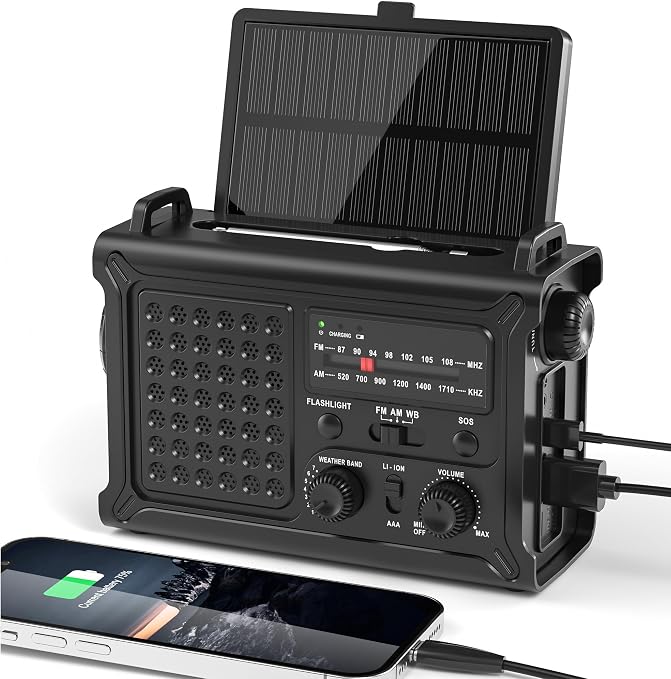
Mesqool 12000mAh Emergency Weather Radio
For: keeping phones topped up through a long outage
- BandsAM, FM, NOAA
- Battery12000 mAh
- Solar8,500 mm² panel
- LightFlashlight + reading lamp
Built around a 12,000 mAh battery, several times the capacity of the budget radios, and a solar panel Mesqool says is over four times larger than typical, so it is the pick if the radio's main job is keeping phones alive. NOAA, AM and FM reception, an upgraded crank, a flashlight and a reading lamp complete it.
What we like
- Big battery
- Large solar panel
- Good flashlight
Watch out for
- No standby alert listed
- Fewer reviews than the long-standing picks

RunningSnail Hand Crank NOAA Radio
For: a radio in every car and go-bag
- BandsAM, FM, NOAA
- PowerBattery, crank, solar
- Weight0.5 lb
- Size5 × 1.8 × 2.4"
Small, light and inexpensive enough to put one in every kit: NOAA weather, AM and FM, a 2,000 mAh battery that can top up a phone, a 1W flashlight, and crank and solar charging. It is one of the most widely reviewed budget crank radios.
What we like
- Very low price
- Half a pound
- Three power sources
Watch out for
- Small speaker
- No AA backup
What NOAA Weather Radio is
NOAA Weather Radio is a network of more than 1,000 transmitters run by the US National Weather Service. It broadcasts continuous forecasts and official warnings for weather and other hazards on seven frequencies between 162.400 and 162.550 MHz. A radio labelled “NOAA” or “WB” receives them. Some radios also have an alert feature that sounds when a warning is issued, and the best of those use S.A.M.E. coding so they only wake you for warnings in your own county.
Hand crank, solar and batteries
- Hand cranks are a backup, not a power supply. A minute of cranking typically buys a few minutes of radio; it will not charge a phone in any useful time.
- Solar panels on emergency radios are small and charge slowly; they are good for topping up the battery in a sunny window over a day.
- A built-in battery does most of the work. Charge it fully before storm season, and every few months after that.
- AA or AAA backup is the most reliable option in a long outage. Radios that take ordinary batteries as well as a built-in pack are worth a premium.
What else to look for
A flashlight or reading lamp, a USB port to give a phone an emergency top-up, an SOS alarm and a headphone jack. Check the size: a radio small enough for a go-bag is usually a weaker receiver than a desk-sized one for the house.
How we rate
We score every pick out of 10 on four things, weighted for what matters when the power is out or the trail is long: whether it does the job when you need it (40%), meaning a filter's rated capacity and what it removes, a radio's reception and charging options, a kit's contents rather than its piece count; build and reliability (25%), including seals, batteries and shelf life and what owners report after months in a closet or a pack; ease of use under stress (20%), whether it can be set up in the dark, with cold hands, by someone who has never used it; and value (15%).
We have not tested these products ourselves. We read the manufacturer's specifications, certifications and instructions and look for the patterns in verified owners' reviews, both the praise and the recurring complaints. No brand pays for placement, and a commission cannot buy a higher rating. When a pick changes, we will say so on this page.
Frequently asked questions
What is the best emergency radio for power outages?
One with NOAA Weather Radio, AM and FM, a built-in rechargeable battery, and at least one backup way to power it: AA batteries, a hand crank or solar. Our top picks are listed above.
Can a hand-crank radio charge a phone?
Only a little. Cranking can add a small amount of charge in an emergency, but it takes a long time; the radio’s built-in battery, charged ahead of time, is far more useful for topping up a phone.
Do I need a NOAA weather radio if I have a phone?
Yes, as a backup. Mobile networks can go down or become overloaded in a disaster, and a weather radio receives official warnings directly from the National Weather Service.

