


Clean water is the first thing to run out in an emergency and the one you can least do without. A portable water filter turns a stream, a rain barrel or a questionable tap into water you can drink, and it weighs a few ounces, so it belongs in every go-bag, car kit and day pack.
We compared filters on what they remove (and what they don’t), how much water they are rated to filter before they wear out, how fast they flow, and how easy they are to use and clean in the field. Most of the picks below are hollow-fibre filters rated to remove bacteria and protozoa; we say where a pick does more.
 Best overallSawyer Mini Water Filtration SystemCheck price
 Simplest to useLifeStraw Personal Water FilterCheck price
 Best for a familySawyer Squeeze Water Filtration SystemCheck price
 Best for questionable waterSurvivor Filter PROCheck price

Sawyer Mini Water Filtration System
For: almost everyone, in a go-bag, car kit or day pack
- Filter0.1 micron absolute
- Ratedup to 100,000 gallons
- Weight2 oz
- UseStraw, pouch, bottle, inline
The most versatile small filter: per Sawyer it removes 99.99999% of bacteria and 99.9999% of protozoa through a 0.1-micron hollow-fibre membrane, and it works as a straw, on the included 16-oz squeeze pouch, screwed onto a standard 28 mm water bottle, or inline on a hydration pack.
Its rated capacity is enormous for its 2-ounce weight, and the included plunger backflushes it to restore the flow, which is what keeps a hollow-fibre filter working for years.
What we like
- Works four different ways
- Tiny, light and inexpensive
- Backflushable for a long life
Watch out for
- The squeeze pouch is the weak point; carry a spare or a bottle
- No viruses or chemicals, like every filter of its kind

LifeStraw Personal Water Filter
For: a no-thinking backup in every kit, and for kids
- RemovesBacteria, parasites, microplastics
- Rated4,000 litres
- UseDrink-through straw
- Tested toEPA / NSF / ASTM protocols
The best-known water filter there is, and among the most-reviewed outdoor products on Amazon. There is nothing to set up: put one end in the water and drink. Per LifeStraw it removes 99.999999% of bacteria and 99.999% of parasites, rated for 4,000 litres.
Because you have to drink at the source, it is a backup rather than your only filter. It costs little enough to put one in every bag in the house.
What we like
- Nothing to learn
- Inexpensive enough for every kit
- Long rated life
Watch out for
- Drink-at-the-source only: can't fill a bottle
- No viruses or chemicals

Sawyer Squeeze Water Filtration System
For: filtering water for several people, or using as a gravity filter
- Filter0.1 micron absolute
- Pouches2 × 32 oz
- UseSqueeze, bottle, inline, gravity
- Weight2 oz filter
The Mini's bigger sibling, with a faster flow and two 32-ounce pouches, so you can fill pots and bottles for a family rather than drink one sip at a time. Sawyer says every unit is tested three times. Hang a pouch from a tree and it works as a gravity filter.
What we like
- Faster flow than the Mini
- Two large pouches included
- Gravity set-up for groups
Watch out for
- Costs more than the Mini
- Pouches need care: don't overfill and squeeze hard

Survivor Filter PRO
For: flood water or sources where viruses or chemicals are a worry
- Stages0.1 µm pre-filter, carbon, 0.01 µm
- Flow500 ml/min
- Weight12.8 oz
- UseHand pump
A hand-pump filter with three replaceable stages: a 0.1-micron pre-filter, a carbon filter for heavy metals and chemicals, and a 0.01-micron ultrafilter. The maker says it removes 99.999% of tested viruses as well as bacteria and protozoa, and reduces heavy metals, to NSF/ANSI standards. That goes beyond the hollow-fibre filters above.
It is bulkier and slower to use, so it is the filter for a home or car kit rather than a pocket.
What we like
- Virus and heavy-metal claims, per the maker
- Replaceable stages
- Pumps into any container
Watch out for
- Heavier than straw and squeeze filters
- More parts to keep track of

Katadyn BeFree 1L Filter Bottle
For: hikers who want to fill and drink in one step
- Filter0.1 micron hollow fibre
- Flow2 L/min
- Ratedup to 1,000 L
- PacksFlat
A soft flask with the filter in the cap: dip it in the stream, screw the cap on and drink. Katadyn rates the flow at 2 litres a minute, very fast for a squeeze filter, and you clean it by shaking it in water rather than backflushing. The trade-off is a shorter rated life than the Sawyers.
What we like
- Fill and drink in seconds
- Very fast flow
- Collapses flat
Watch out for
- Lower rated capacity
- Soft flask is less durable than a hard bottle

LifeStraw Peak Series Straw
For: a tougher straw that also fits bottles and gravity hoses
- Flow2.5 L/min
- Rated4,000 L
- FitsBottles, gravity hoses
- BuildLeak-proof, drop-resistant
LifeStraw's updated straw is built tougher than the original, with a membrane redesigned to clog less from silt, and a threaded cap so it can screw onto a bottle or a gravity hose. Per LifeStraw it filters 2.5 litres a minute and is rated for 4,000 litres.
What we like
- Fits bottles and gravity set-ups
- Fast flow for a straw
- More durable build
Watch out for
- Costs a little more than the classic LifeStraw

Waterdrop Gravity Water Filter Straw with 1.5-gal Bag
For: filtering a few gallons for a household with no pumping
- Bag1.5 gallons
- Rated1,400 gallons
- Flowup to 700 ml/min
- Stages5, incl. 0.1 µm
A filter straw paired with a 1.5-gallon gravity bag: fill the bag, hang it up and let water run through into a pot while you do something else. Waterdrop rates the filter for 1,400 gallons, and it can be backwashed when the flow slows. A sensible set-up for a home emergency kit.
What we like
- Hands-free gravity filtering
- Big bag for a household
- Backwashable
Watch out for
- Slower than a squeeze filter
- Bag needs somewhere to hang
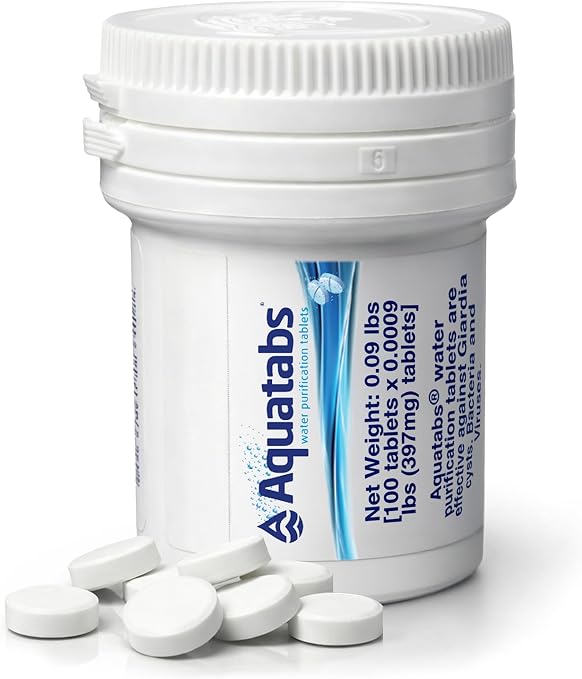
Aquatabs Water Purification Tablets (100 pack)
For: treating viruses after filtering, and a light backup
- TreatsBacteria, viruses, cysts
- Count100 tablets
- TasteNo iodine taste
- ExpiryFeb 2029 (current stock)
The other half of a good water kit. Per the maker, Aquatabs remove 99.9999% of bacteria, 99.99% of viruses and 99.9% of Giardia cysts, with no iodine taste. Filter cloudy water first, then add a tablet and wait the time on the packet. A pack this size covers a family's kit for years.
What we like
- Deals with viruses
- Weighs almost nothing
- Long shelf life
Watch out for
- You have to wait before drinking
- Does nothing for sediment or chemicals
Filter, purifier or tablets?
- A filter pushes water through a membrane with holes too small for bacteria and protozoa to pass. Hollow-fibre filters such as the Sawyer and LifeStraw are typically rated at 0.1 to 0.2 microns. They remove no viruses, which are far smaller, and no dissolved chemicals.
- A purifier also deals with viruses, through a finer membrane, a chemical stage or ultraviolet light.
- Chemical tablets (chlorine dioxide or sodium dichloroisocyanurate) are light and cheap and kill viruses, but take 30 minutes to four hours depending on the product and water temperature, and do nothing for cloudy water or chemicals.
- Boiling is the CDC’s most reliable method for killing pathogens: a rolling boil for one minute, or three minutes above 6,500 feet.
For a home emergency kit, a filter plus a pack of tablets covers most situations. Pre-filter cloudy water through a cloth or coffee filter first: silt clogs any filter fast.
What to compare
- Rated capacity: how many litres or gallons the filter can treat before it is spent. Some are rated in thousands of litres; straws are often rated far lower.
- How you drink: a straw needs you at the water’s edge; a squeeze filter screws onto a pouch or bottle; a gravity filter hangs from a tree and fills a pot for a group while you do something else.
- Freezing: a hollow-fibre filter that freezes wet can crack and fail without any visible sign. In cold weather, keep it in an inside pocket or sleeping bag.
- Backflushing: filters that can be backflushed with a syringe or clean water keep their flow rate for longer.
How we rate
We score every pick out of 10 on four things, weighted for what matters when the power is out or the trail is long: whether it does the job when you need it (40%), meaning a filter's rated capacity and what it removes, a radio's reception and charging options, a kit's contents rather than its piece count; build and reliability (25%), including seals, batteries and shelf life and what owners report after months in a closet or a pack; ease of use under stress (20%), whether it can be set up in the dark, with cold hands, by someone who has never used it; and value (15%).
We have not tested these products ourselves. We read the manufacturer's specifications, certifications and instructions and look for the patterns in verified owners' reviews, both the praise and the recurring complaints. No brand pays for placement, and a commission cannot buy a higher rating. When a pick changes, we will say so on this page.
Frequently asked questions
Do portable water filters remove viruses?
Most do not. Hollow-fibre filters remove bacteria and protozoa, but viruses are too small. If viruses are a concern, boil the water or use a chemical disinfectant rated for viruses after filtering.
How long does a water filter last?
Each filter has a rated capacity, from a few hundred to many thousands of litres, set by the manufacturer. Flow slows as it clogs; backflushing helps. Replace it if it has frozen while wet or if the manufacturer’s integrity test fails.
Is a LifeStraw or a Sawyer better?
They do the same job with the same kind of filter. The LifeStraw is a simple straw; the Sawyer Mini is more versatile because it can screw onto a pouch or bottle, inline on a hydration pack, or work as a straw. See the picks for details.
Can I filter tap water during a boil-water notice?
Follow the notice: health departments usually say to boil, because a filter may not remove viruses. A filter is useful for removing sediment first.

